IGCSE Maths Formula Sheets
The IGCSE Maths formula sheet printed in every Pearson Edexcel International GCSE paper gives Higher students thirteen formulae and Foundation students four; everything else, including Pythagoras and the circle formulae, must be memorised. This page lists exactly what is printed on the Pearson Edexcel International GCSE formulae sheet for both tiers, sets out the formulae you have to remember, and gives you a free A3 wall poster of both lists and topic sheets sized for your phone’s lock screen. Everything is readable on the page; the downloads are optional.
IGCSE Maths formula sheet: what the exam gives you, and what it does not
On the Higher tier the formulae sheet hands you the quadratic formula, the sine and cosine rules, the area of a triangle as ½ab sin C, the arithmetic series sum, the area of a trapezium, the volume of a prism, the volume and curved surface area of a cylinder and a cone, and the volume and surface area of a sphere. Thirteen formulae.
It does not give you Pythagoras, SOHCAHTOA, the area or circumference of a circle, or anything at all from number, graphs or statistics. Those you have to know, and this page shows you which.
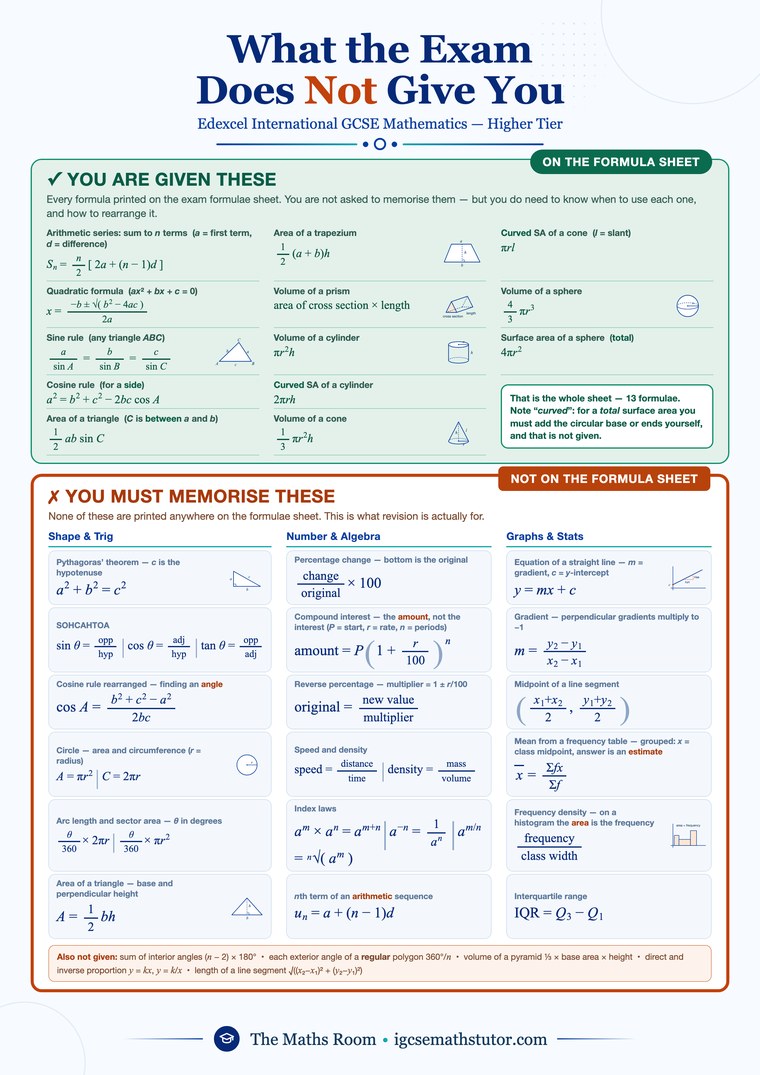
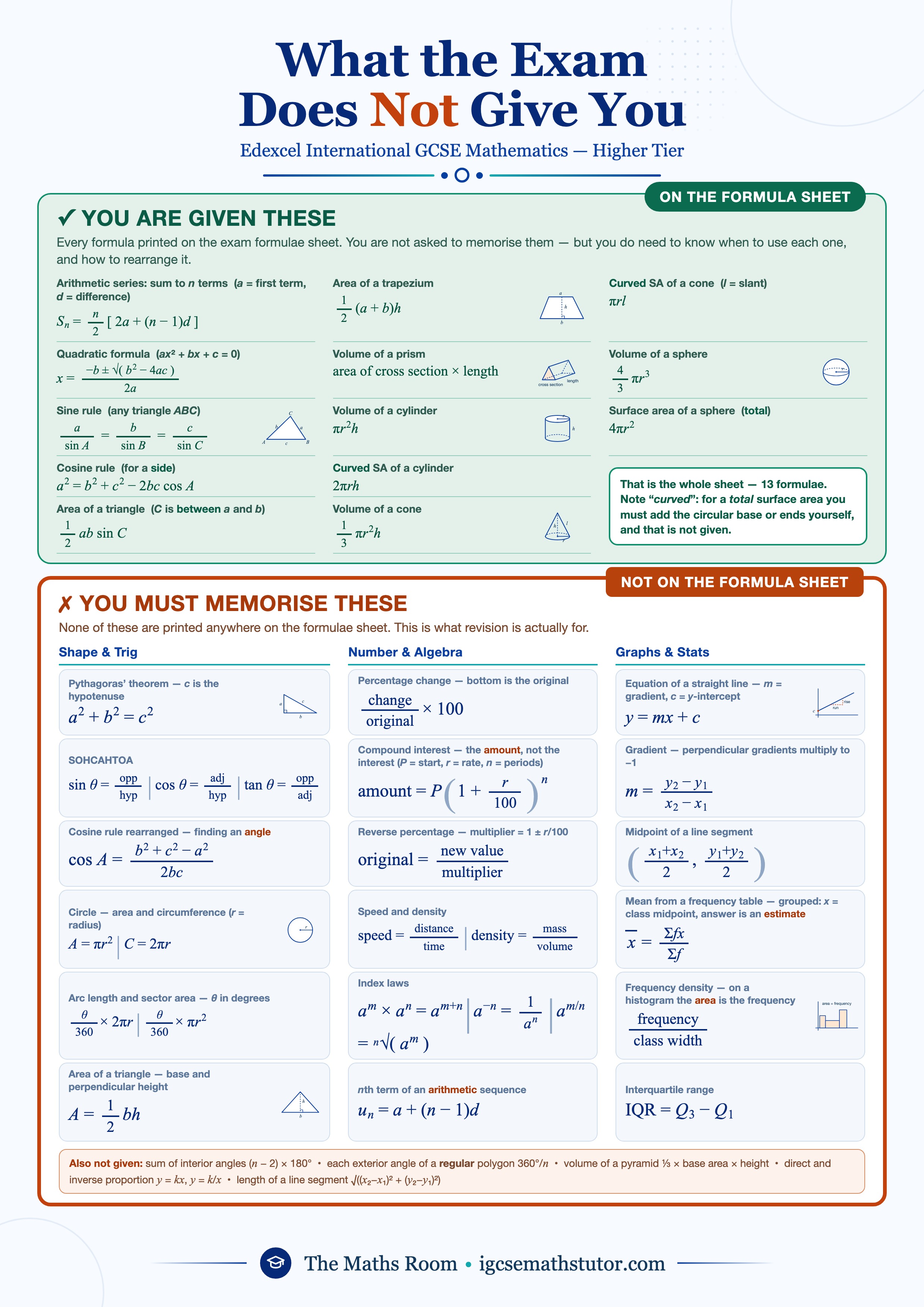
Both lists side by side on one sheet. Prints on A4 too.
What Is on the Exam Formula Sheet?
A formulae sheet is printed in the front of every Pearson Edexcel International GCSE Mathematics paper. This is its complete contents — nothing else on this page is given to you.
✓ Higher tier — everything you are given
- Arithmetic series — sum to \( n \) terms
- \( S_n = \dfrac{n}{2}\left[\,2a + (n-1)d\,\right] \)
- a is the first term, d the common difference (the gap between terms) and n how many terms you are adding. Lesson: sum of an arithmetic sequence →
- The quadratic equation — solutions of \( ax^2 + bx + c = 0 \), where \( a \neq 0 \)
- \( x = \dfrac{-b \pm \sqrt{b^2 - 4ac}}{2a} \)
- Use it when the quadratic will not factorise. a, b and c are the numbers in front of x², x and on its own; the ± gives the two solutions. Lesson: the quadratic formula →
- Sine rule — in any triangle \( ABC \)
- \( \dfrac{a}{\sin A} = \dfrac{b}{\sin B} = \dfrac{c}{\sin C} \)
- Cosine rule
- \( a^2 = b^2 + c^2 - 2bc\cos A \)
- Area of triangle
- \( \dfrac{1}{2}ab\sin C \)
- Capital letters are angles, small letters the sides opposite them. Sine rule: a side with its opposite angle. Cosine rule: two sides and the angle between them. Area: C is the angle between sides a and b. Sine rule → · Cosine rule →
- Area of trapezium
- \( \dfrac{1}{2}(a+b)h \)
- a and b are the two parallel sides; h is the perpendicular distance between them, not the sloping side.
- Volume of prism
- area of cross section \( \times \) length
- A prism has the same cross section all the way through. Find the area of that end shape, then multiply by the length. Lesson: prisms and cylinders →
- Volume of cylinder
- \( \pi r^2 h \)
- Curved surface area of cylinder
- \( 2\pi r h \)
- r is the radius of the circular end, h the height. Curved means the tube only: add two circles of πr² for the total surface area. Lesson: prisms and cylinders →
- Volume of cone
- \( \dfrac{1}{3}\pi r^2 h \)
- Curved surface area of cone
- \( \pi r l \)
- r is the base radius, h the perpendicular height and l the slant height from the apex to the rim. r, h and l make a right-angled triangle, so Pythagoras links them. Lesson: cones and frustums →
- Volume of sphere
- \( \dfrac{4}{3}\pi r^3 \)
- Surface area of sphere
- \( 4\pi r^2 \)
- r is the radius. This surface area is the total; there is nothing to add.
✓ Foundation tier — everything you are given
- Area of trapezium
- \( \dfrac{1}{2}(a+b)h \)
- a and b are the two parallel sides; h is the perpendicular distance between them, not the sloping side.
- Volume of prism
- area of cross section \( \times \) length
- A prism has the same cross section all the way through. Find the area of that end shape, then multiply by the length. Lesson: prisms and cylinders →
- Volume of cylinder
- \( \pi r^2 h \)
- Curved surface area of cylinder
- \( 2\pi r h \)
- r is the radius of the circular end, h the height. Curved means the tube only: add two circles of πr² for the total surface area. Lesson: prisms and cylinders →
That is the whole Foundation sheet — four formulae. Everything else, including the area and circumference of a circle, has to be memorised.
What You Must Memorise
The sheet is generous with the awkward 3D solids and the triangle rules, and gives you nothing at all for the topics you meet most often. These come up constantly and are not printed on the formulae sheet.
✎ Not on the sheet — learn these
- Pythagoras’ theorem
- \( a^2 + b^2 = c^2 \)
- c is the hypotenuse, the longest side, opposite the right angle. Right-angled triangles only. Lesson: Pythagoras →
- The three trigonometric ratios (SOHCAHTOA)
- \( \sin\theta = \dfrac{\text{opp}}{\text{hyp}} \), \( \cos\theta = \dfrac{\text{adj}}{\text{hyp}} \), \( \tan\theta = \dfrac{\text{opp}}{\text{adj}} \)
- Label the sides from the angle θ: opposite is across from it, adjacent is next to it, and the hypotenuse is opposite the right angle. Right-angled triangles only. Lesson: SOHCAHTOA →
- Area of a circle
- \( \pi r^2 \)
- Circumference of a circle
- \( 2\pi r \)
- r is the radius. If you are given the diameter, halve it first (or use C = πd). Lesson: circles, arcs and sectors →
- Area of a triangle (base and height)
- \( \dfrac{1}{2}bh \)
- b is the base and h the perpendicular height measured from that base, not a sloping side. Lesson: area of a triangle →
- Equation of a straight line
- \( y = mx + c \)
- Gradient between two points
- \( m = \dfrac{y_2 - y_1}{x_2 - x_1} \)
- m is the gradient, how steep the line is: rise ÷ run between any two points on it. c is the y-intercept, where the line crosses the y-axis. Parallel lines share m; perpendicular gradients multiply to −1. Equation of a line → · Gradient →
- Percentage change
- \( \dfrac{\text{change}}{\text{original}} \times 100 \)
- The bottom is always the original value, the amount before the change, never the new one. Lesson: percentage change →
- Compound interest — this gives the amount, not the interest
- \( \text{amount} = P\left(1 + \dfrac{r}{100}\right)^{n} \)
- P is the starting amount, r the rate per period and n the number of periods. The interest earned is amount − P. Lesson: compound interest →
- Speed
- \( \dfrac{\text{distance}}{\text{time}} \)
- Density
- \( \dfrac{\text{mass}}{\text{volume}} \)
- Cover the one you want: distance = speed × time, time = distance ÷ speed; mass = density × volume. Lesson: compound measures →
- Mean from a frequency table
- \( \dfrac{\sum fx}{\sum f} \)
- Multiply each value x by its frequency f, add those up, then divide by the total frequency. For grouped data use the midpoint of each class, and the answer is an estimate. Lesson: averages from grouped data →
- Frequency density
- \( \dfrac{\text{frequency}}{\text{class width}} \)
- On a histogram the bars are drawn to frequency density, so the area of a bar (height × class width) is the frequency. Lesson: histograms →
- The index laws
- \( a^m \times a^n = a^{m+n} \), \( a^{-n} = \dfrac{1}{a^n} \), \( a^{\frac{m}{n}} = \sqrt[n]{a^m} \)
- Same base only. A negative power means one over; a fractional power m/n means the nth root, then the mth power. Lesson: indices →
Two traps worth noticing. The sheet gives the area of a triangle as \( \tfrac{1}{2}ab\sin C \) but not as \( \tfrac{1}{2}bh \), so the everyday version is the one to remember. And on Higher it gives the sum of an arithmetic series, not the \( n \)th term \( a + (n-1)d \) — you have to know that one.
Free Poster and Phone Sheets for the Must-Memorise List
There is no point revising what the paper hands you. These are free: one A3 wall poster with both lists side by side, and three phone-sized sheets that split the must-memorise list by topic.
The wall poster — everything on one sheet
Both lists side by side on one A3 sheet: the complete exam formulae sheet in green, and every formula you have to carry in your head in orange. Print it, put it on the wall, and you can see at a glance what is worth revising. Prints cleanly on A4 too.
Or take it a section at a time, sized for your phone
Shape & Trig
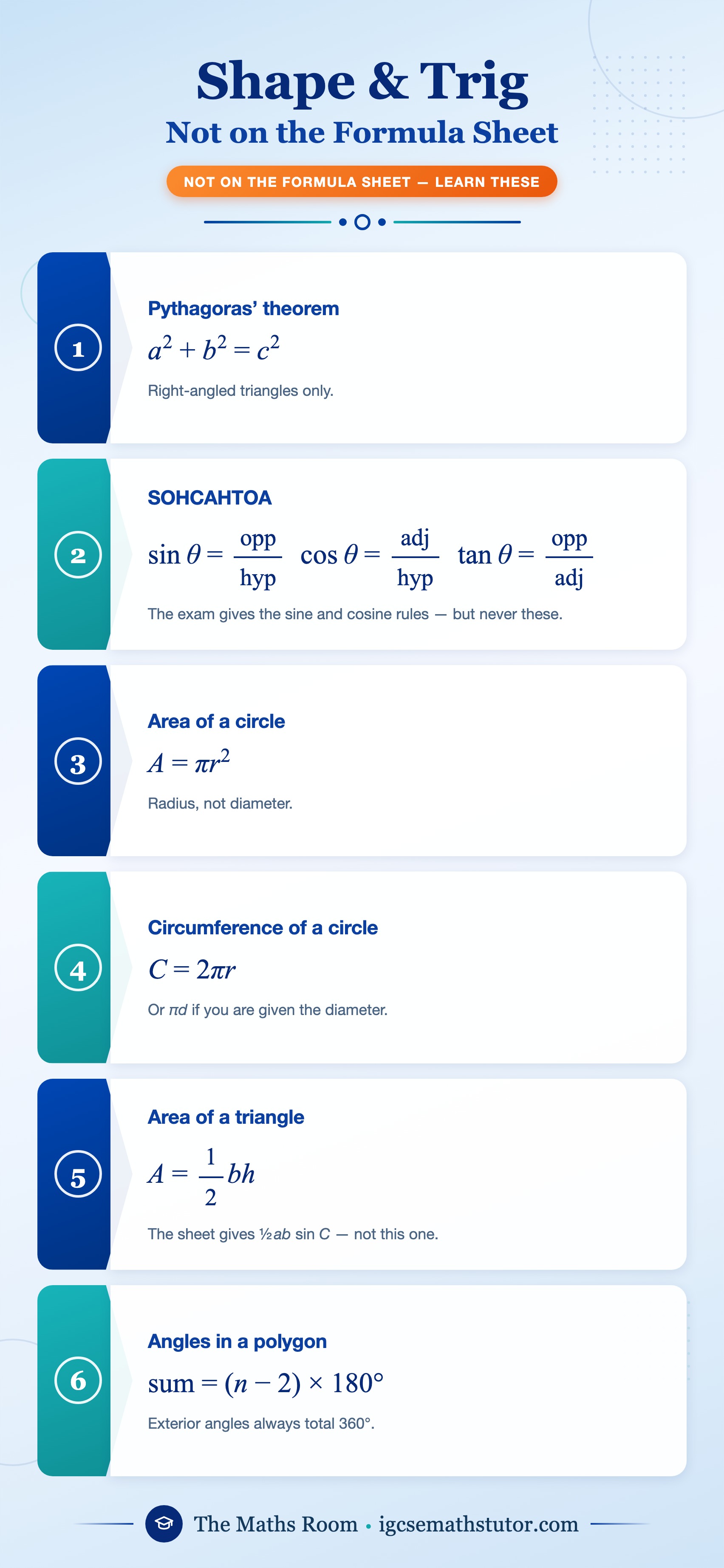
Pythagoras, SOHCAHTOA, area and circumference of a circle, area of a triangle and the polygon angle sum.
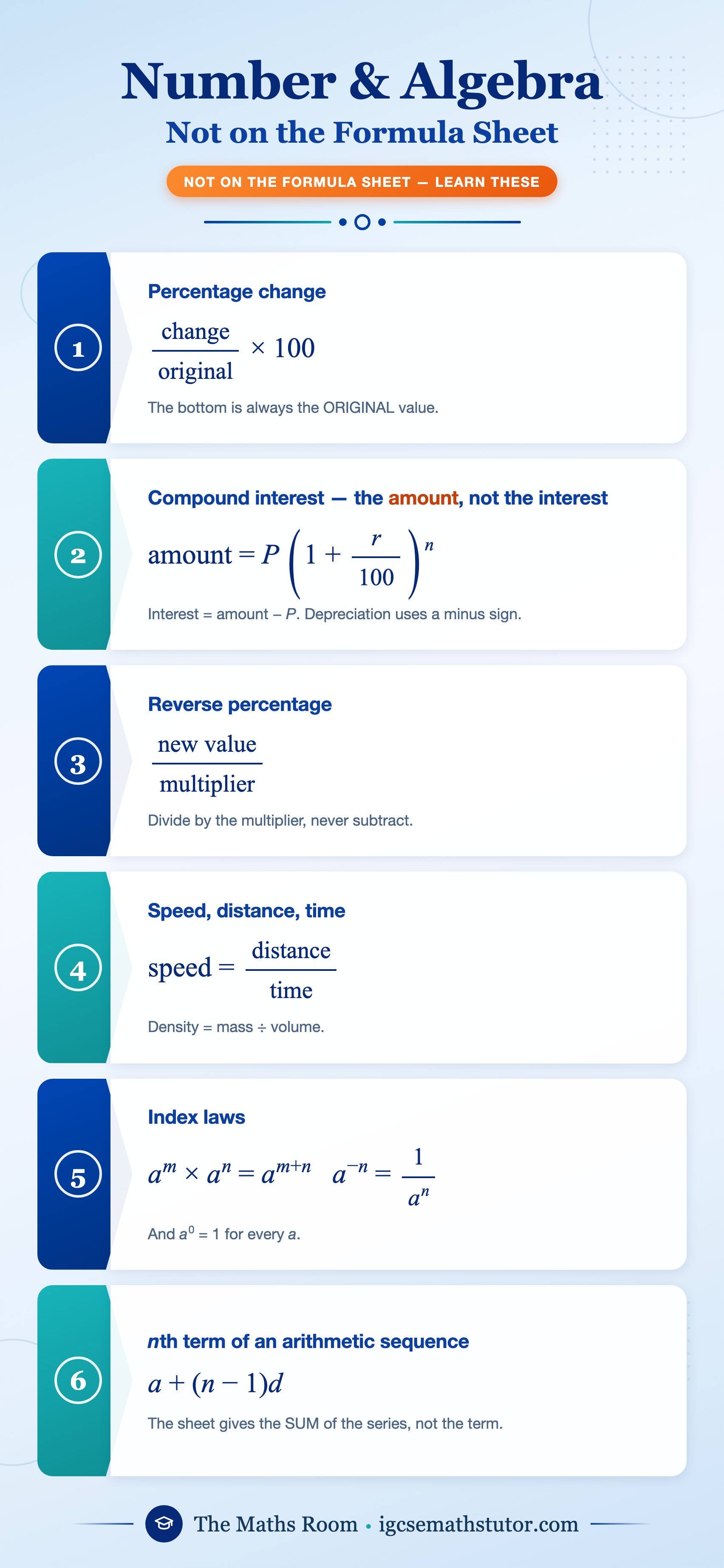
Number & Algebra
Percentage change, compound interest, reverse percentages, speed and density, the index laws and the nth term.
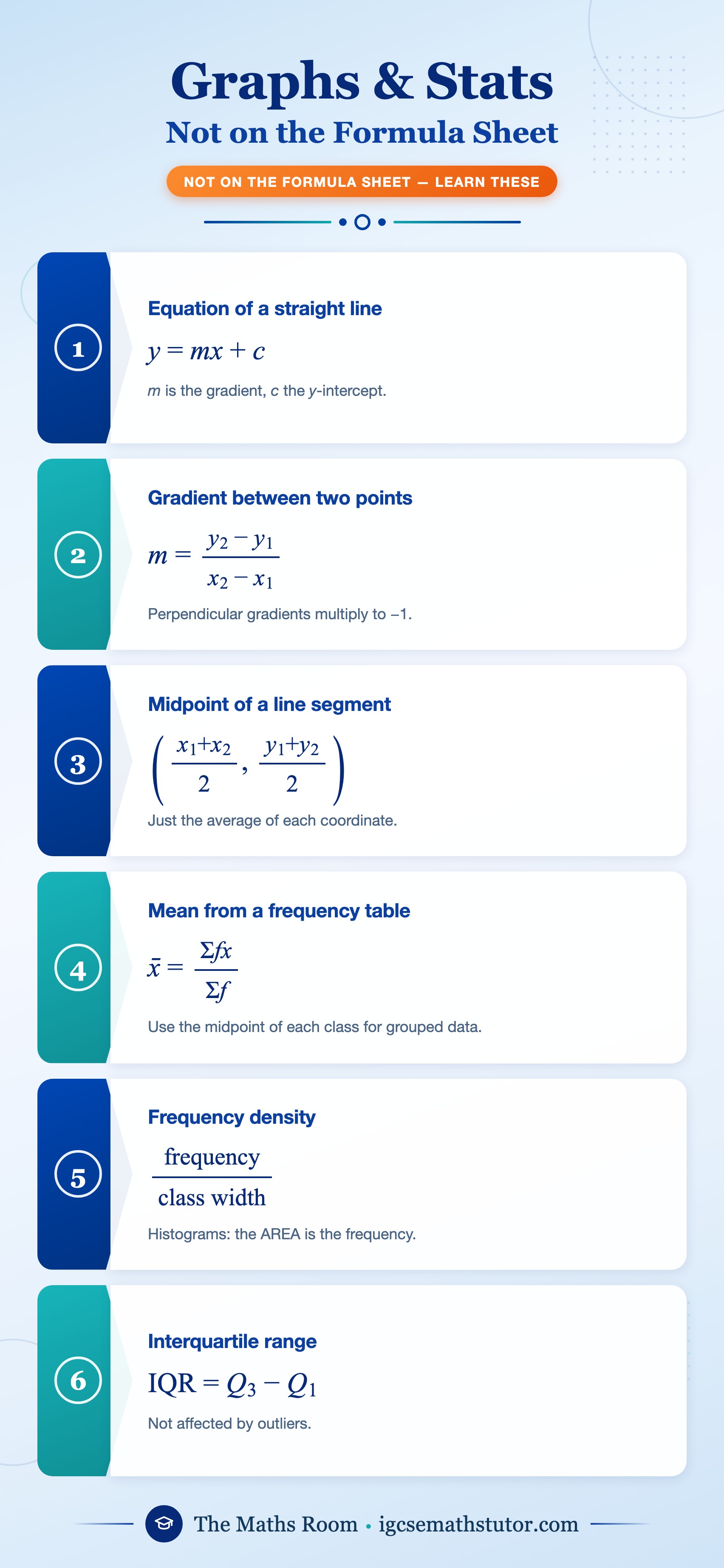
Graphs & Stats
y = mx + c, gradient, midpoint, mean from a frequency table, frequency density and the interquartile range.
Every Formula on the Ten Lock-Screen Sheets, in Full
The ten lock-screen sheets further down are images, so a search engine or a screen reader cannot read the formulae inside them. Here are the formulae they carry as text, together with the percentage formulae, which none of the ten sheets covers.
Number and percentages
- Percentage change
- \( \dfrac{\text{change}}{\text{original}} \times 100 \)
- Percentage increase or decrease
- multiply by \( 1 + \dfrac{r}{100} \) or \( 1 - \dfrac{r}{100} \)
- Reverse percentage
- \( \dfrac{\text{new value}}{\text{multiplier}} \)
- Amount after \( n \) years of compound interest
- \( P\left(1 + \dfrac{r}{100}\right)^{n} \)
- Standard form
- \( a \times 10^{n} \), where \( 1 \leqslant a < 10 \)
- Bounds of a rounded value
- value \( \pm \) half the degree of accuracy
Algebra rules
- Expanding a single bracket
- \( a(b + c) = ab + ac \)
- Expanding double brackets
- \( (x + a)(x + b) = x^2 + (a + b)x + ab \)
- Difference of two squares
- \( a^2 - b^2 = (a + b)(a - b) \)
Indices and surds
- Multiplying powers
- \( a^m \times a^n = a^{m+n} \)
- Dividing powers
- \( a^m \div a^n = a^{m-n} \)
- Power of a power
- \( \left(a^m\right)^n = a^{mn} \)
- Zero index
- \( a^0 = 1 \)
- Negative index
- \( a^{-n} = \dfrac{1}{a^n} \)
- Fractional index
- \( a^{\frac{m}{n}} = \sqrt[n]{a^m} \)
- Multiplying surds
- \( \sqrt{a} \times \sqrt{b} = \sqrt{ab} \)
- Rationalising a denominator
- multiply top and bottom by \( \sqrt{b} \)
Equations, inequalities and sequences
- The quadratic formula
- \( x = \dfrac{-b \pm \sqrt{b^2 - 4ac}}{2a} \)
- Discriminant
- \( b^2 - 4ac \)
- \( n \)th term of an arithmetic sequence
- \( a + (n-1)d \)
- Sum to \( n \) terms
- \( S_n = \dfrac{n}{2}\left[\,2a + (n-1)d\,\right] \)
Graphs and functions
- Equation of a straight line
- \( y = mx + c \)
- Gradient between two points
- \( m = \dfrac{y_2 - y_1}{x_2 - x_1} \)
- Parallel lines
- equal gradients
- Perpendicular lines
- \( m_1 m_2 = -1 \)
- Midpoint of a line segment
- \( \left( \dfrac{x_1+x_2}{2},\; \dfrac{y_1+y_2}{2} \right) \)
- Length of a line segment
- \( \sqrt{(x_2-x_1)^2 + (y_2-y_1)^2} \)
Angles and polygons
- Angles on a straight line
- add to \( 180^\circ \)
- Angles around a point
- add to \( 360^\circ \)
- Angles in a triangle
- add to \( 180^\circ \)
- Interior angle sum of an \( n \)-sided polygon
- \( (n - 2) \times 180^\circ \)
- Exterior angles of any polygon
- add to \( 360^\circ \)
- Each exterior angle of a regular polygon
- \( \dfrac{360^\circ}{n} \)
Area, perimeter and volume
- Area of a triangle
- \( \dfrac{1}{2}bh \)
- Area of a trapezium
- \( \dfrac{1}{2}(a+b)h \)
- Circumference of a circle
- \( 2\pi r \)
- Area of a circle
- \( \pi r^2 \)
- Volume of a prism
- area of cross section \( \times \) length
- Volume of a cylinder
- \( \pi r^2 h \)
- Curved surface area of a cylinder
- \( 2\pi r h \)
- Volume of a cone
- \( \dfrac{1}{3}\pi r^2 h \)
- Curved surface area of a cone
- \( \pi r l \)
- Volume of a sphere
- \( \dfrac{4}{3}\pi r^3 \)
- Surface area of a sphere
- \( 4\pi r^2 \)
Trigonometry and Pythagoras
- Pythagoras’ theorem
- \( a^2 + b^2 = c^2 \)
- Sine ratio
- \( \sin\theta = \dfrac{\text{opposite}}{\text{hypotenuse}} \)
- Cosine ratio
- \( \cos\theta = \dfrac{\text{adjacent}}{\text{hypotenuse}} \)
- Tangent ratio
- \( \tan\theta = \dfrac{\text{opposite}}{\text{adjacent}} \)
- Sine rule
- \( \dfrac{a}{\sin A} = \dfrac{b}{\sin B} = \dfrac{c}{\sin C} \)
- Cosine rule
- \( a^2 = b^2 + c^2 - 2bc\cos A \)
- Area of a triangle (two sides and the included angle)
- \( \dfrac{1}{2}ab\sin C \)
Statistics and probability
- Mean from a frequency table
- \( \dfrac{\sum fx}{\sum f} \)
- Range
- largest value \( - \) smallest value
- Interquartile range
- \( Q_3 - Q_1 \)
- Frequency density
- \( \dfrac{\text{frequency}}{\text{class width}} \)
- An event not happening
- \( P(\text{not } A) = 1 - P(A) \)
- Independent events
- \( P(A \text{ and } B) = P(A) \times P(B) \)
- Mutually exclusive events
- \( P(A \text{ or } B) = P(A) + P(B) \)
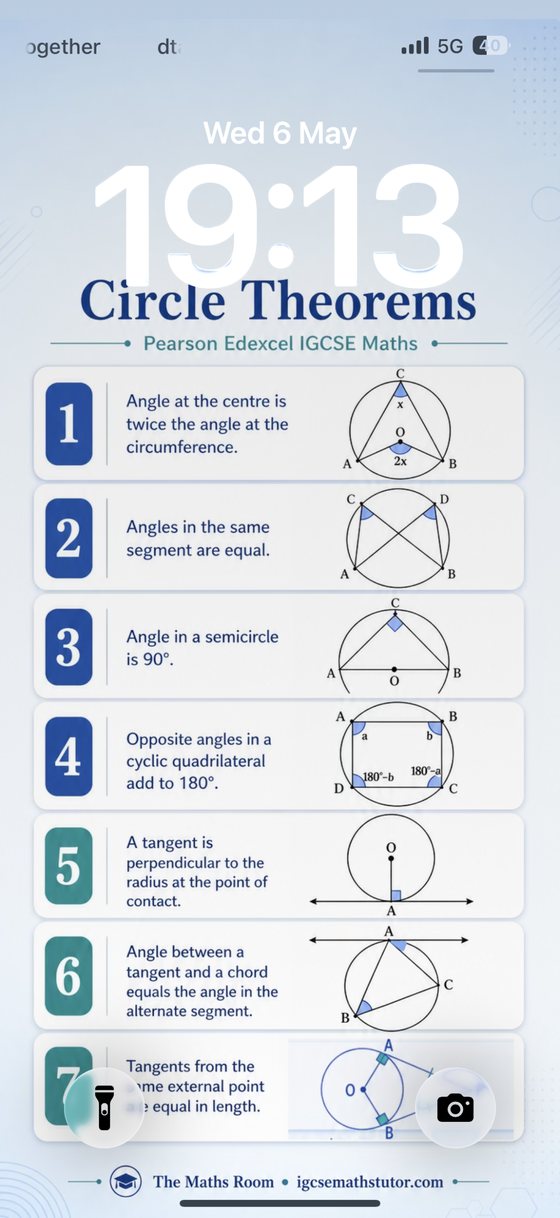
Put Maths on Your Lock Screen
Ten free formula sheets covering the Pearson Edexcel IGCSE Maths syllabus. Each one is sized to fit a phone screen, so every time you pick up your phone you get a quick revision hit. No signup, no email, no fuss.
⬇ Download All 10 Sheets (ZIP)Or grab individual sheets below.
How to Set as Your Lock Screen
The best setup is to use Photo Shuffle on iPhone or an equivalent carousel option on Android, with the images selected manually. This lets you adjust each one so the clock does not cover the important content.
iPhone (Photo Shuffle)
- Save the formula sheets to your Photos.
- Long-press on your lock screen.
- Tap the + button to add a new lock screen.
- Select Photo Shuffle.
- Choose Select Photos Manually.
- Select the formula sheets you want to use.
- Tap Add (or the tick).
- For each image, zoom out and centre it so the clock does not cover the main content.
- Choose how often the image should change:
- On Tap: changes when you tap the lock screen.
- On Lock: changes each time you lock your phone.
- Hourly: changes every hour.
- Daily: changes once a day.
- Tap Add, then set it as your lock screen.
Android (Lock Screen Shuffle)
Android phones vary by model, so the steps may differ slightly.
- Save the formula sheets to your phone.
- Create a folder or album called IGCSE Maths Revision in Gallery or Photos.
- Open your phone's wallpaper settings.
- Look for Lock screen wallpaper, Wallpaper services, Wallpaper carousel, Dynamic lock screen, or Slideshow.
- Choose the IGCSE Maths Revision folder or album if your phone allows this.
- Set it to change automatically if that option is available.
- Adjust each image so the clock does not cover the key information.
- Save it as your lock screen.
How to Use These Sheets
Choose a topic you find difficult and set it as your lock screen for a few days. Every time you see it, test yourself before reading the details. Ask yourself:
- What is the formula?
- What does the diagram show?
- Can I remember the rule before looking?
Small repeated exposure to something you check 80 times a day adds up fast. Rotate to a new topic once you know it.
Choose Your Lock-Screen Sheet
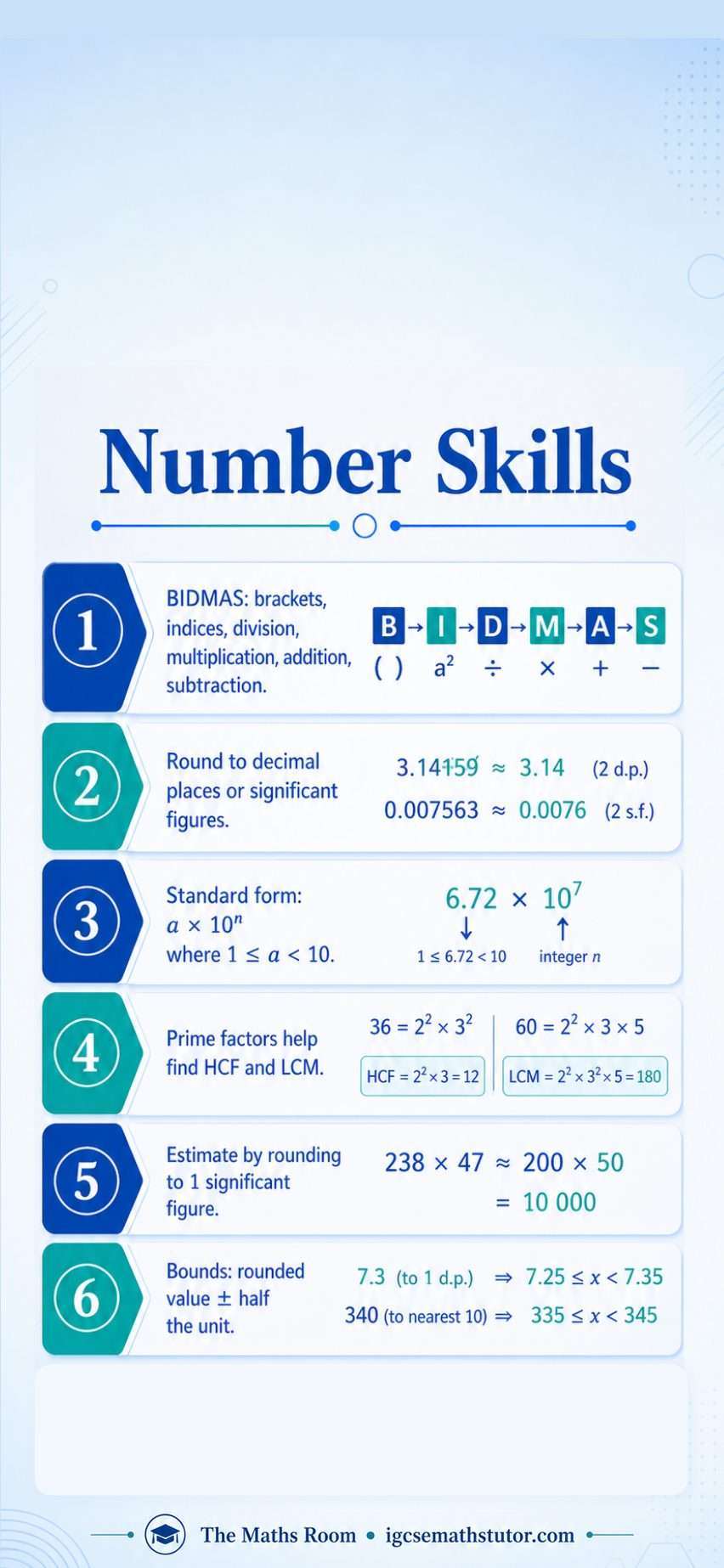
Number Skills
BIDMAS, rounding, significant figures, standard form, HCF and LCM, estimation, upper and lower bounds.
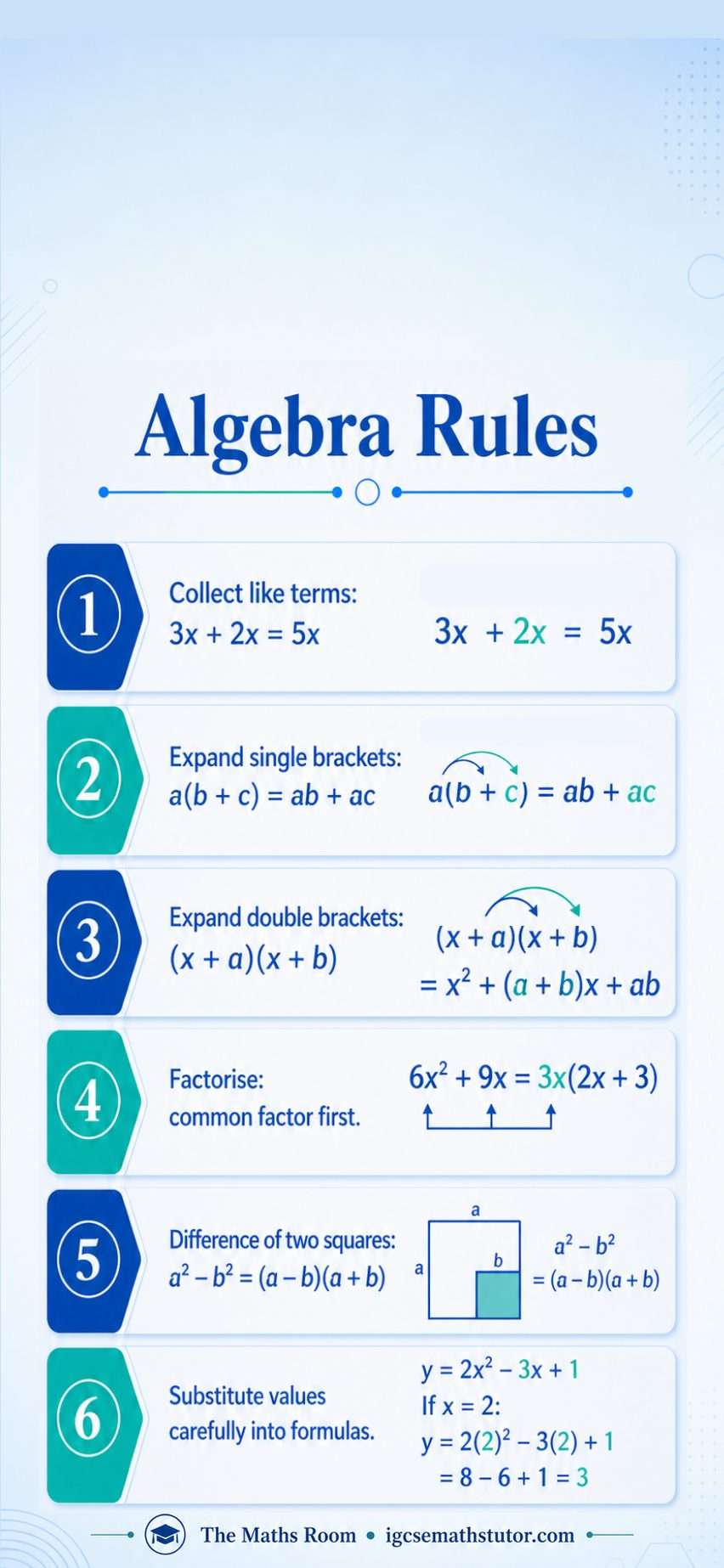
Algebra Rules
Collecting like terms, expanding single and double brackets, factorising, difference of two squares, substitution.
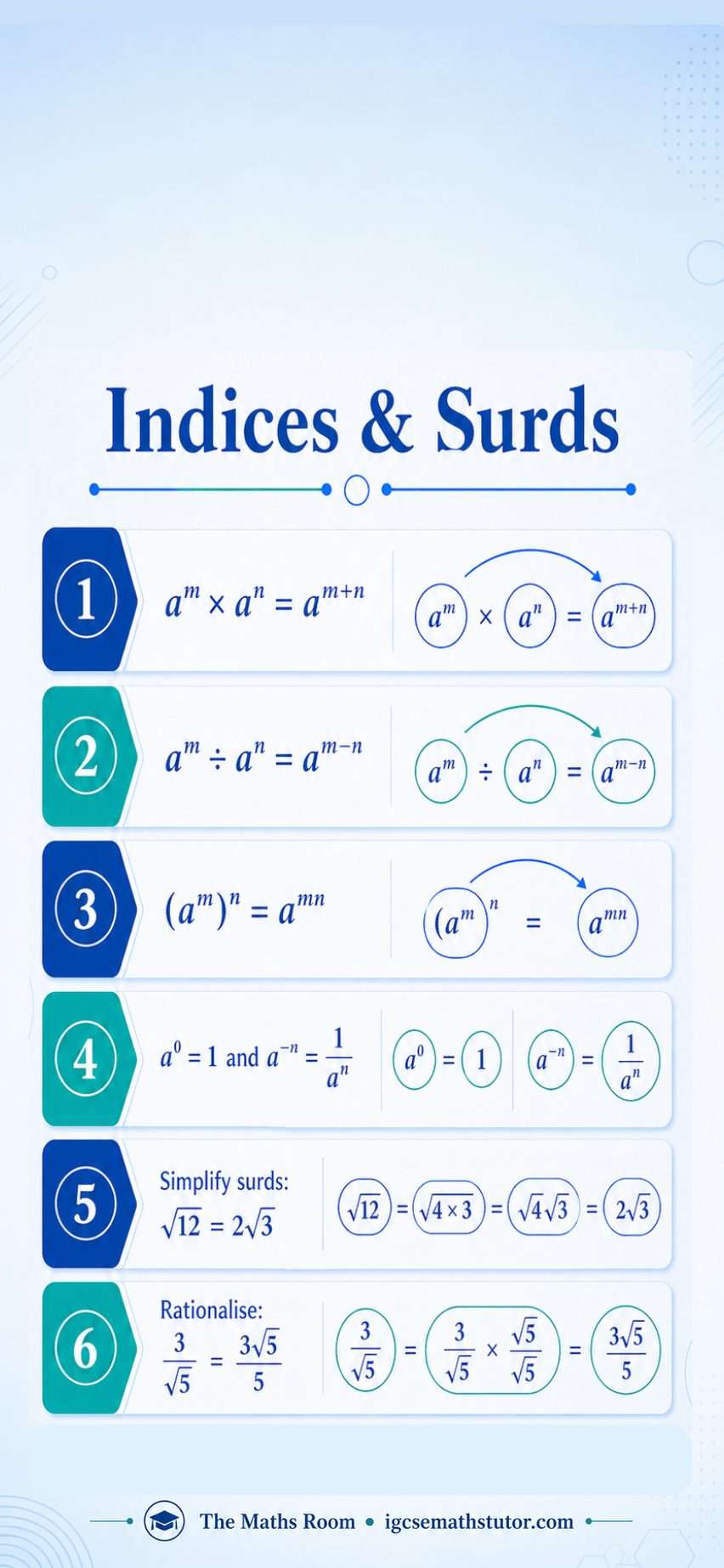
Indices & Surds
The three index laws, zero and negative powers, simplifying surds, rationalising the denominator.
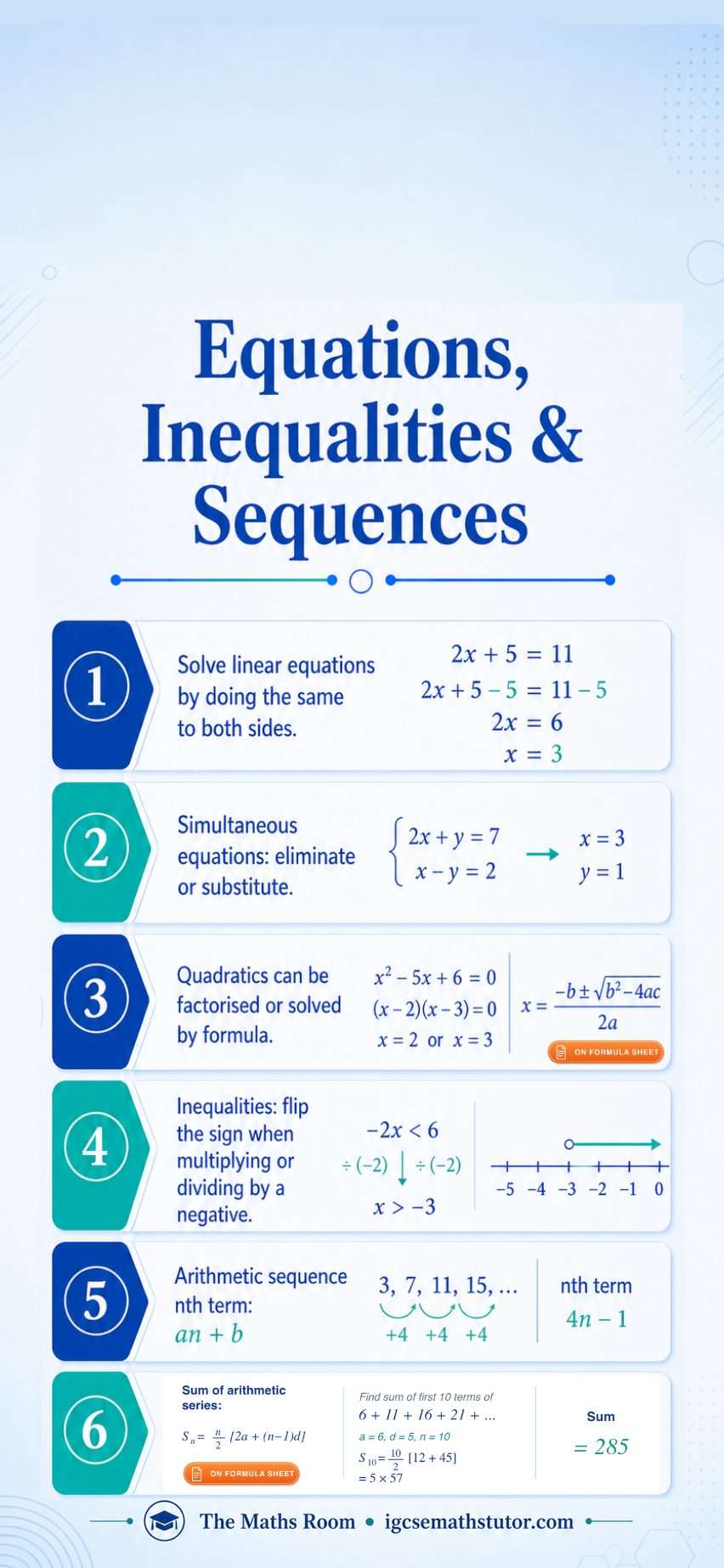
Equations, Inequalities & Sequences
Linear and simultaneous equations, quadratic formula, inequality rules, nth term of an arithmetic sequence, sum of an arithmetic series.
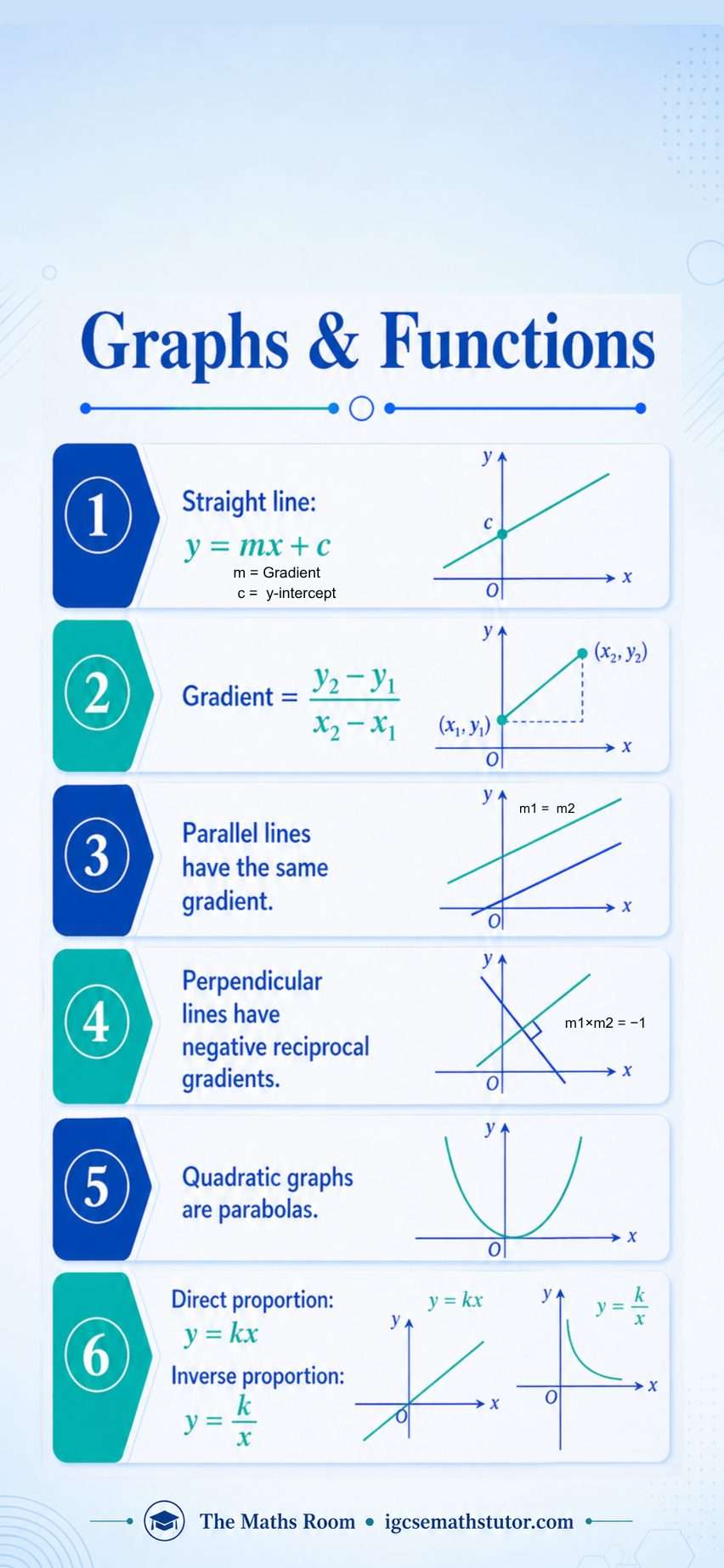
Graphs & Functions
Straight line equation, gradient formula, parallel and perpendicular gradients, quadratic graphs, direct and inverse proportion.
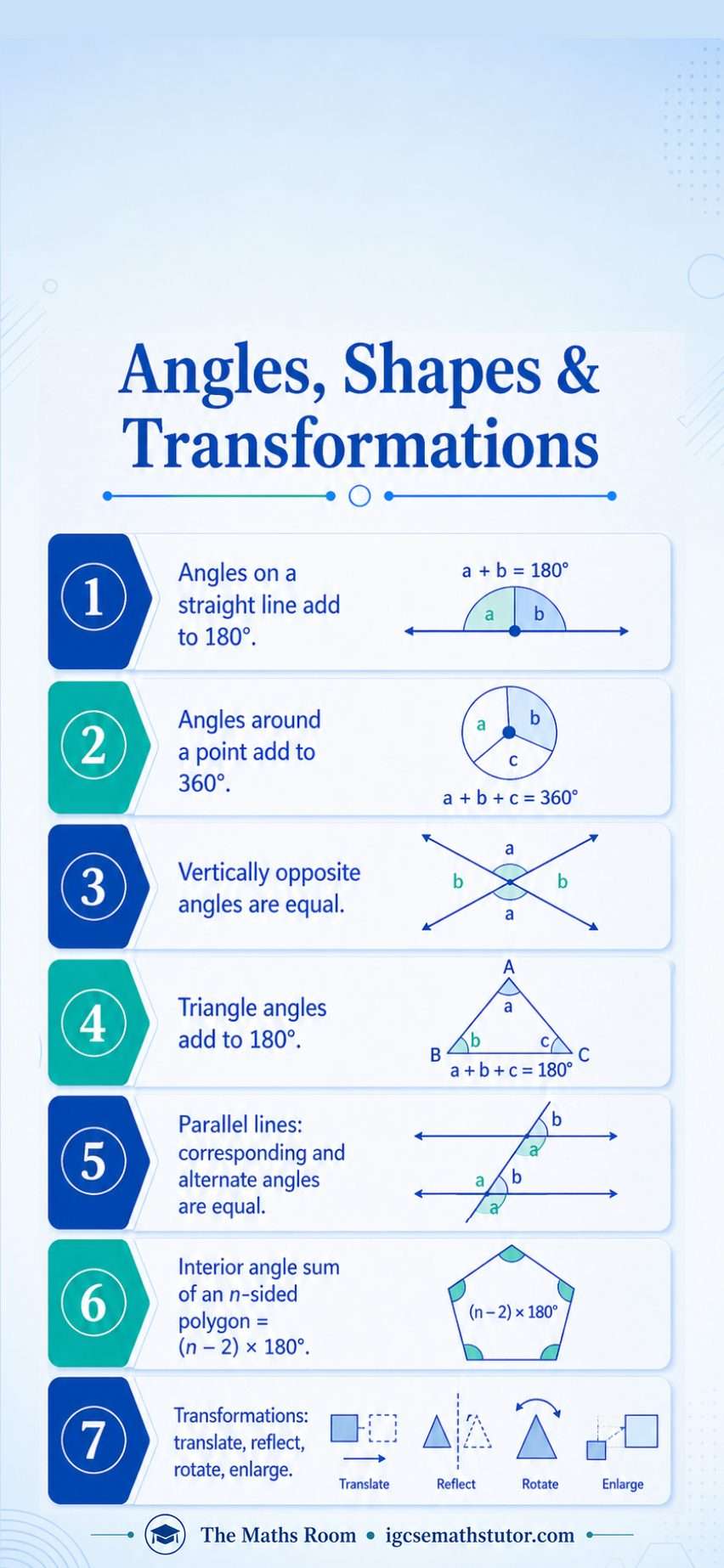
Angles, Shapes & Transformations
Angle facts on lines, around a point and in triangles, parallel line angles, polygon interior angle sum, the four transformations.
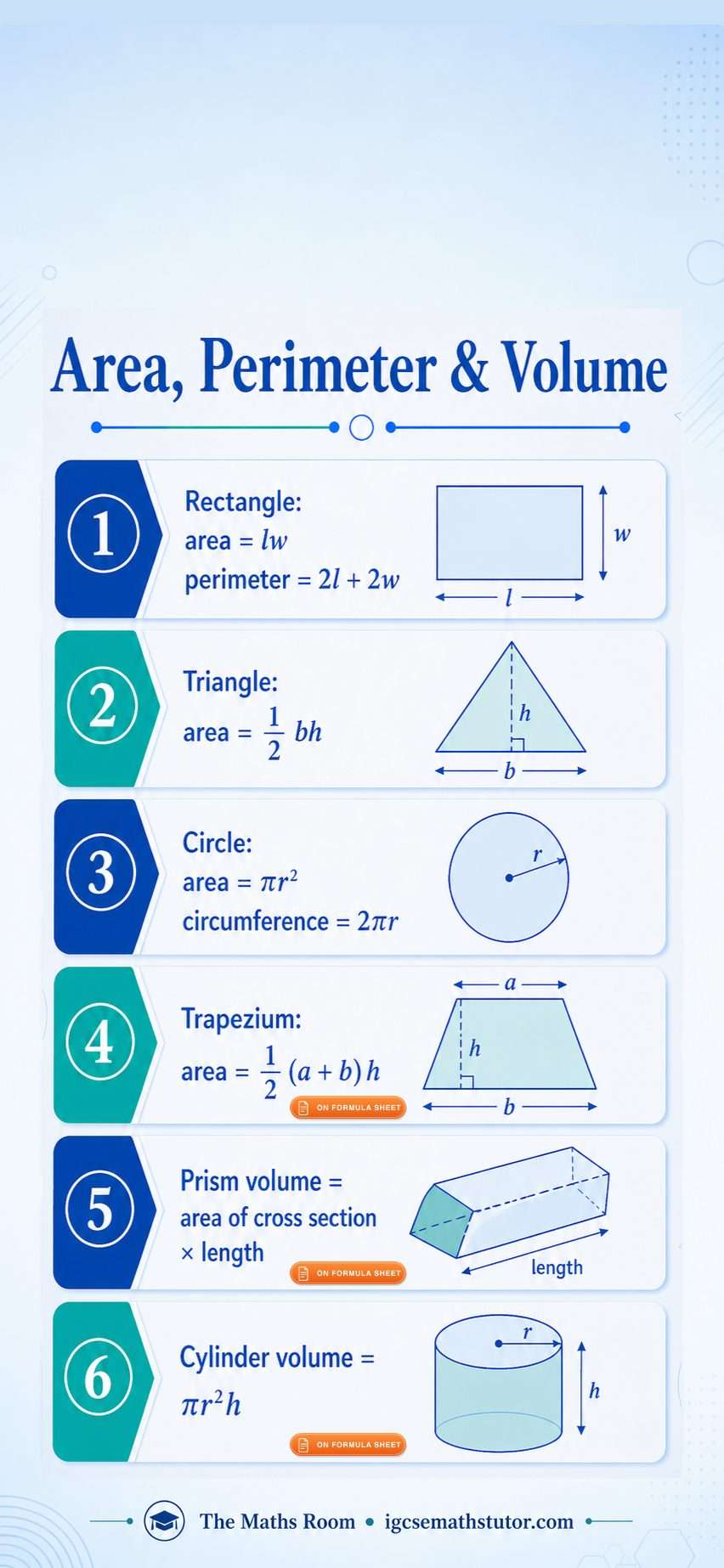
Area, Perimeter & Volume
Rectangle, triangle, circle and trapezium area, circle circumference, prism and cylinder volumes.
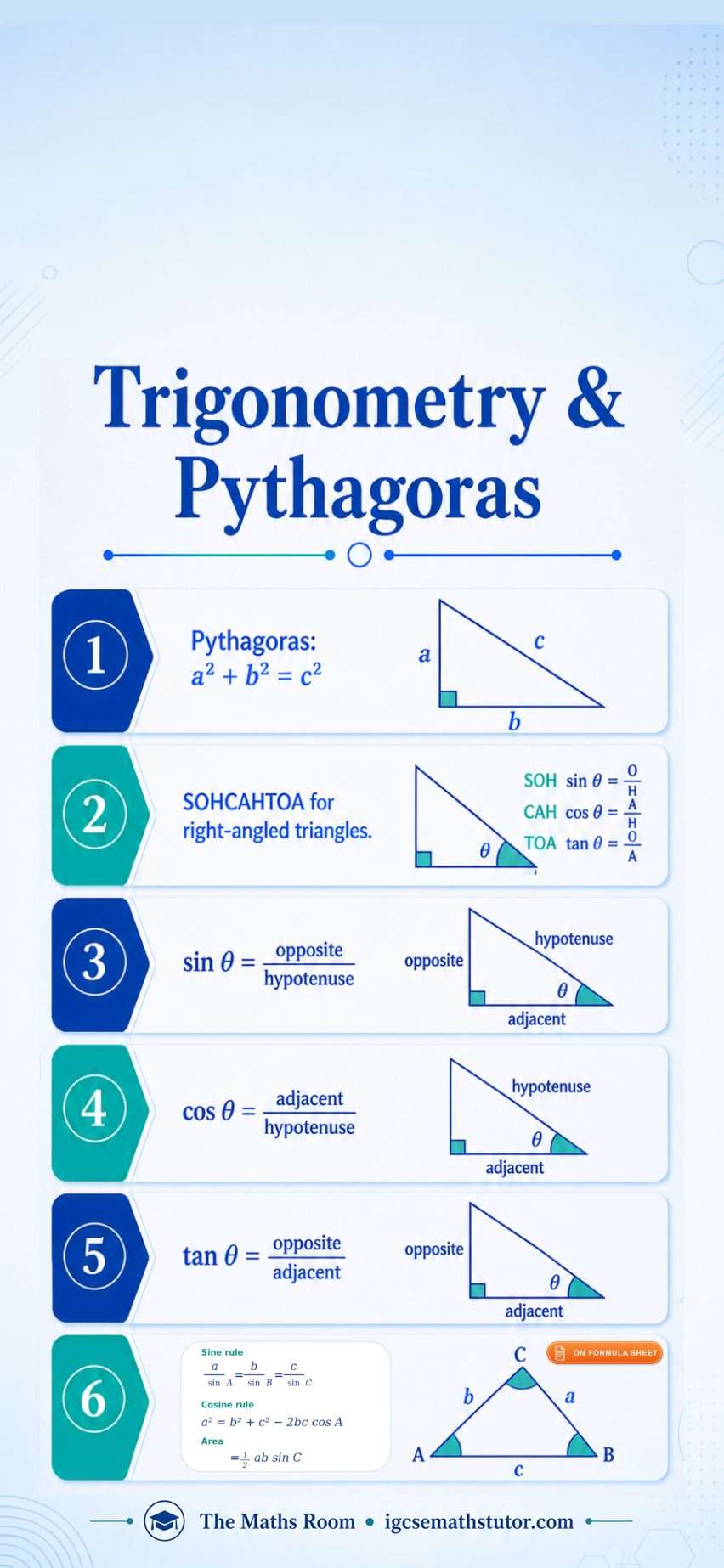
Trigonometry & Pythagoras
Pythagoras' theorem, SOHCAHTOA for right-angled triangles, sine and cosine rules, triangle area formula.
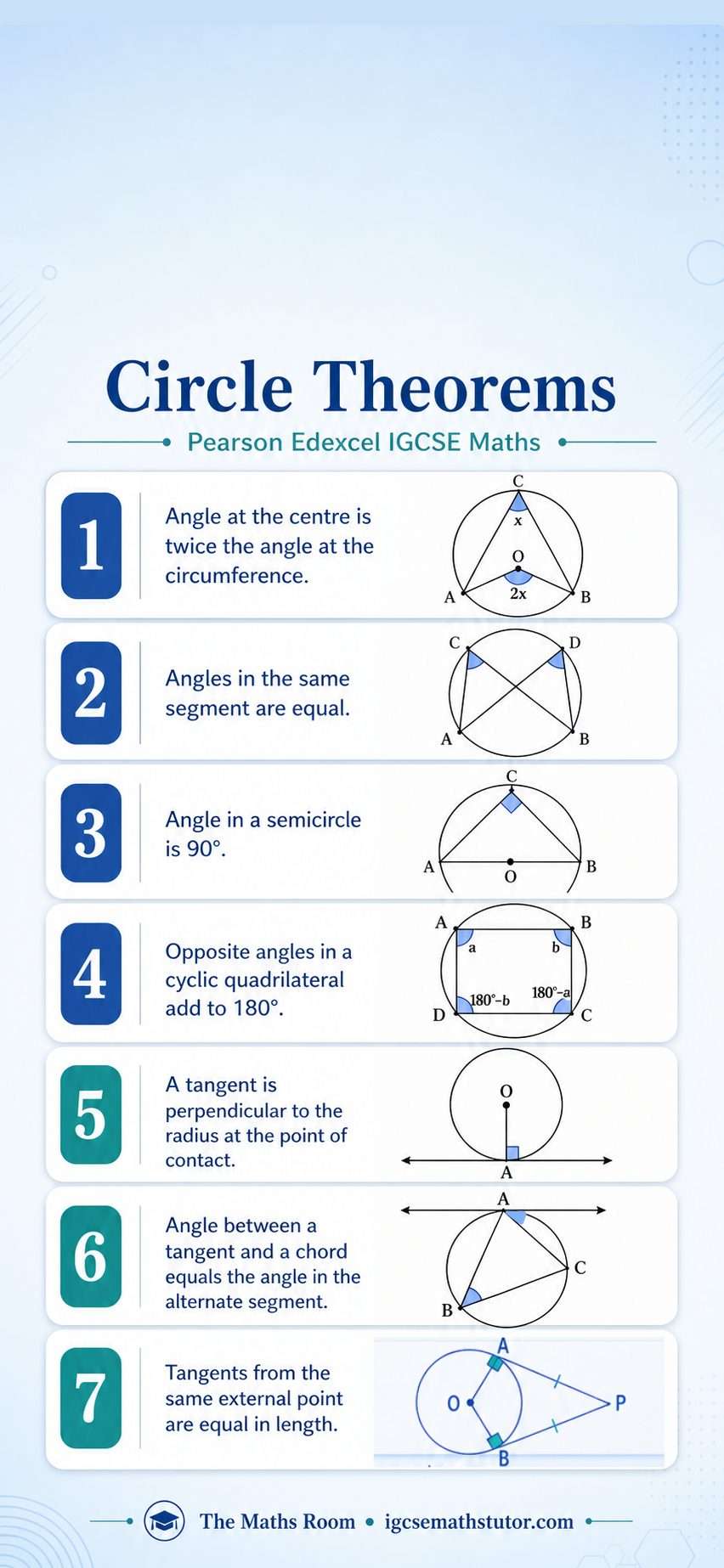
Circle Theorems
All seven circle theorems: angle at the centre, same segment, semicircle, cyclic quadrilateral, tangent rules, alternate segment.
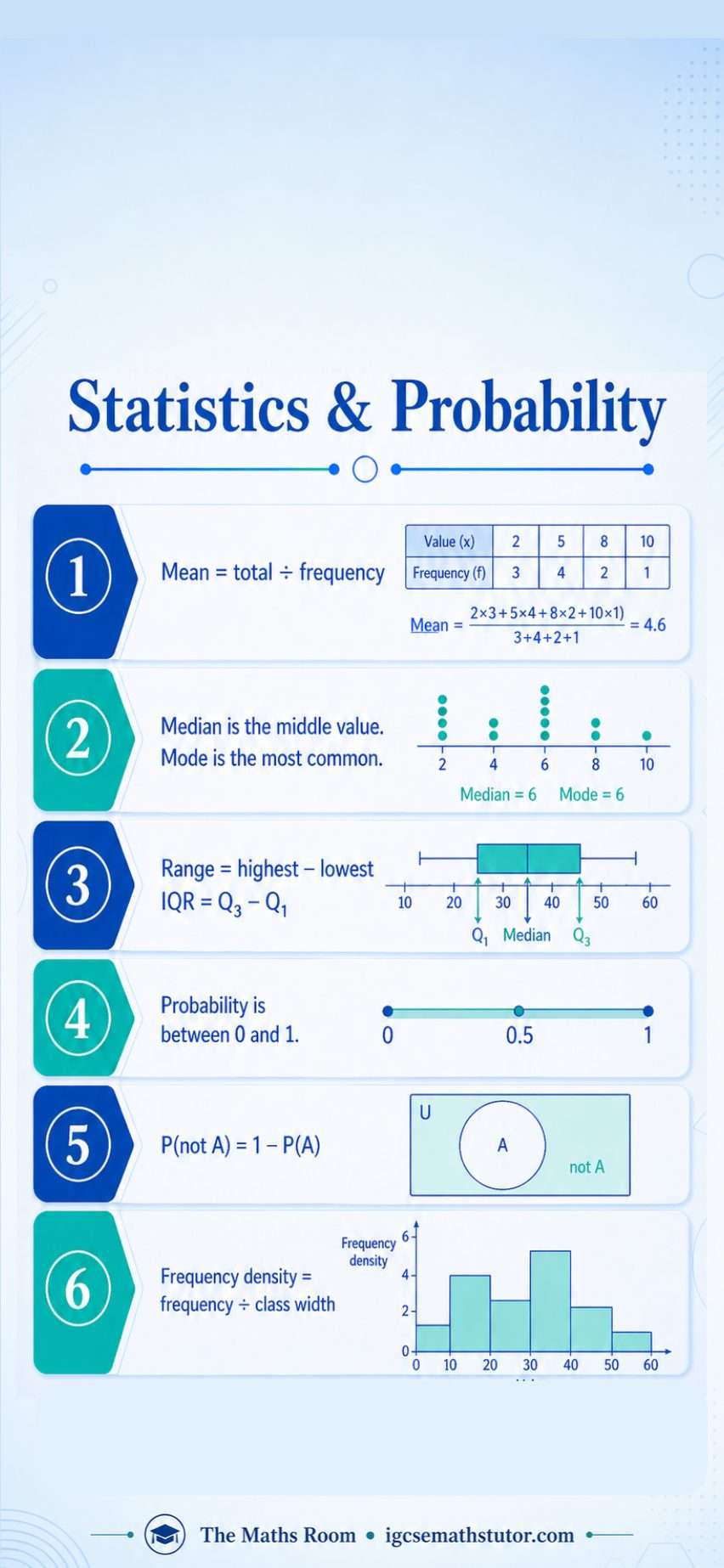
Statistics & Probability
Mean from a frequency table, median, mode, range, interquartile range, probability rules, frequency density for histograms.